Thursday, 31 October 2013

Chap 7 Strategy for competing in international markets

This week we continue with chapter 7 which is mention about strategies for competing in international markets. From this chapter what i learn is we can understand the primary reasons companies choose to compete in international markets. Second, learn how and why market conditions across countries influence a company's strategies. Third, learn the five majors strategies options for enter foreign markets and gain familiarity with three main strategies approach for competing. Next, understand how multinational companies are able to use international operations to improve overall competitiveness.

Why some companies decide to enter foreign market???To get a lot of profit??I think this is one of the reasons but actually it have five majors reasons. First, to gain access to new customers, achieve lower costs through economics of scale, experience, and increase purchasing power, further exploit its core competencies. Next to access to the resources and capabilities located in foreign markets.  And last to spread its business risk across a wider market base. And why the company compete across national borders makes strategies making more complex?? This is because different countries have different home country advantage in different industries. Second, there are location based advantage to conducting particular value chain activities in different parts of the world. Third, different government policies, tax rates, inflation rates, and others economics conditions make the general business climate more favorable in some countries than in others. Fourth, companies face risk due to adverse shifts in currency exchange rates when operating in foreign markets. And finally, differences in buyers tastes and preferences present a challengers for companies concerning customizing versus standing their products and services.

When an organization has made a decision to enter an overseas market, there are a variety of options open to it. These options vary with cost, risk and the degree of control which can be exercised over them. The simplest form of entry strategy is exporting using either a direct or indirect method such as an agent, in the case of the former, or counter trade, in the case of the latter. More complex forms include truly global operations which may involve joint ventures, or export processing zones. Having decided on the form of export strategy, decisions have to be made on the specific channels. Many agricultural products of a raw or commodity nature use agents, distributors or involve Government, whereas processed materials, whilst not excluding these, rely more heavily on more sophisticated forms of access. These will be expanded on later.

Having done all the preparatory planning work (no mean task in itself!), the prospective global marketer has then to decide on a market entry strategy and a marketing mix. These are two main ways of foreign market entry-either by entering from a home market base, via direct or indirect exporting, or by foreign based production. Within these two possibilities, marketers can adopt an "aggressive" or "passive" export path.
Entry from the home base (direct) includes the use of agents, distributors, Government and overseas subsidiaries and (indirect) includes the use of trading companies, export management companies, piggybacking or counter trade. Entry from a foreign base includes licensing, joint ventures, contract manufacture, ownership and export processing zones. Each method has its peculiar advantages and disadvantages which the marketer must carefully consider before making a choice.


During our tutorial class also discuss about case study Piping hot dogs-a case of a Malaysian franchise-

First of all we need to know what the strategies that uses in this business. What are the structure, the rivalry, and also need to analysis our competitive pricing strategy. There have three solution which is buyer stage, factor condition and related and supporting industry. Okay first, we have 5 stage level of ages for know the buyers which is :

  1. Baby/todlers
  2. 12-15 years old
  3. 15-23 years old
  4. 24-25 years old
  5. 45 and above
We need to know how the ages can influences the buying process.

Next, what is factor condition? We need to look at the price and what the ingredient or raw materials that were use in produce the hot dogs whether in  lower or high price. From where they get the chicken and how the chicken deliver to Malaysia.


And finally what the related industry does make the similar business? For example, Ramly nuggets, Ayamas brand and so on also produce the same things. But what is special in this Nineteen O One Sdn Bhd they use Halal ingredients and also get the HALAL certificate from JAKIM. So Muslims people didn't worry to buy because today many cases that involve HARAM ingredients while in making hot dogs. So as a consumer we need to be more careful in buying hot dogs. We also need to look at the opportunity and threat that the company use. The company use their own recipe, re branding and also super brand, and also use different packaging that different from the others. They use red and green plastic packaging to make them is interesting and attract customers. Thats all..:) 


Wednesday, 23 October 2013

Chapter 6 Strengthening a company's competitive position: strategies moves, timing, & scope of operations.

Erm actually i don't know what to write now..This is because the clock shown 11.37 pm and I felt so sleepy. But before i continue my sleep i want to share something. Okay, this week i will learn about strengthening a company's competitive position: Strategies moves, timing, and scope of operations. First of all we need to know what the objectives in this topics ok :)...


Learn whether and when to pursue offensive or defensive strategic moves to improve a company's market position.

Recognize when being a first mover or a fast follower or a late mover is most advantageous.

Become aware of the strategic benefits and risks of expanding a company's horizontal scope through mergers and acquisitions.

Learn the advantages and disadvantages of extending the company's scope of operations via vertical integration.

Become aware of the conditions that favor farming out certain value chain activities to outside parties.

Understand when and how strategic alliances can substitute for horizontal mergers and acquisitions or vertical integration and how they can facilitate outsourcing.

After we know all of the objectives i want to make conclusion by this topic. This is because this topic is quite long. Companies can make a number of different strategic moves to build competitive advantage. The aim is to create a clear difference that is important to your customers, and is something your competitors cannot match. You can create competitive advantage by developing a strategy of leadership in factors such as cost, quality, innovation and customer experience. Erm from that i think all companies should have their own strength because it is more important to develop success when making something.
Look at this picture..Based on this picture we can know this is important in company have their merger and also acquisition. What is MERGER? As i know merger is a combination of two things, especially companies, into one. So when one team combine together we can get the best result and achieve the success. ACQUISITION??? Its means combination in which firms the acquire purchases and absorbs the operations of another firm, the acquired.

 During my tutorial class, we try to solve the case about the digital age shall I tag along? So what i get from this lesson is all about SWOT analysis.

  
This is what can I share with all of u..Thanks for reading..;) 

Wednesday, 9 October 2013

Chapter 5 The five generic competitive strategies


1) Air Asia, proton, Malaysia airliners
2) Giant, Tesco, Kamdar, McDonalds, KFC
3)  Bonia, louis vuitton, victoria secrets, honda, old town kopitiam, JW Marriott, Victoria's secret
4)  Porsche

Before continue with summary chapter 5 i will answer few question from my lecturer. I choose on broad differentiation because easy to all of people know what is that means. It means strategy maintains a presence in both segments of the market. Competitive advantage is gained by distinguishing products with an excellent design, high awareness, and easy accessibility. R&D competency is developed that keeps designs fresh and exciting. Products keep pace with the market, offering improved size and performance. Prices are above average. Capacity is expanded as higher demand is generated.

In this week i were continue with the five generic competitive strategies. You know what is that???There are two factor that distinguish one strategies from another. First, market target or narrow and second competitive advantage pursued linked to low costs or product differentiation. 

Okay,,lets we start with strategic. What??Strategic?? First of all what is strategies???? "Strategy is the direction and scope of an organisation over the long-term: which achieves advantage for the organisation through its configuration of resources within a challenging environment, to meet the needs of markets and to fulfil stakeholder expectations".

# A low cost strategy: striving to be the overall low-cost provider of a product or service that appeals to a broad range of customers.

# A broad differentiation strategy: seeking to differentiate the company’s product offerings from rivals’ in ways that will appeal to a broad range of buyers LIKE Whole Foods (emphasis on health foods and organic groceries)]. 

# A best-cost provider strategy: giving customers more value for the money by emphasizing both low cost and upscale difference, the goal being to keep costs and prices lower than those of other providers of comparable quality and features (a couple of examples are the Honda and Toyota car companies with customer satisfaction ratings that rival those of much more expensive cars).

# A focused, or market-niche, strategy based on lower cost: concentrating on a narrow buyer segment and out competing rivals on the basis of lower cost (The Gap is a good example).

# A focused, or market-niche, strategy based on differentiation: offering niche members a product or service customized to their tastes and requirements [examples are Rolls-Royce (sells limited number of high-end, custom-built cars) and men's big and tall shops (sell mainstream styles to a limited market with specific requirements)].

Generic Strategies Mini-Lecture

Wednesday, 2 October 2013

Chapter 4 Evaluating a company's resources, capabilitites and competitiveness

Today i learn about evaluating a company's resources, capabilities, and competitiveness...I think this topics is so interesting because we can know our strength and weaknesses..


 Key points:
#How company's strategy is working 
#Why company's  resources and capabilities
#How to assess the company strength (swot)
#The value chain activities affect
#Comprehensive evaluation of a company competitive situation

And i think all of you want to know about WHAT ARE THE COMPANY'S COMPETITIVELY IMPORTANT RESOURCES AND CAPABILITIES. Right????

Resources and capability analysis provide managers with a powerful tool for sizing up the company's competitive assets and determining whether they can provide the foundation necessary for competitive  success in the marketplace...There are two types of company resources..First tangible resources and second intangible resources..

#Tangible resources -physical, financial, organization resources and technological assets.
#Intangible resources- human assets and intelectual capital, brands, company image and representational assets, relationship and company culture and incentive systems.

Next what is competitive advantages??? An advantage that a firm has over its competitors, allowing it to generate greater sales or margins or retain more customers than its competition. There can be many types of competitive advantages including the firm's cost structure, product offerings, distribution network and customer support.

Tacit knowledge??What is that??This term of words is the first time that i heard..So i found this meaning is unwritten, unspoken, and hidden vast storehouse of knowledge held by practically every normal human being, based on his or her emotions, experiences, insights, intuition, observations and internalized information. Tacit knowledge is integral to the entirety of a person's consciousness, is acquired largely through association with other people, and requires joint or shared activities to be imparted from on to another.

Sunday, 29 September 2013

Chapter 3 The external assessment and internal assessment

Today this class is so happy...We were move to next chapter about internal and external assessments..Erm i think is so interesting for us to learn more about that..If you have an established business where the mission is established then, most often, the mission guides the vision statement and the rest of the strategic plan. Either way, you need to know your fundamental purpose: the mission, your current situation in terms of internal resources and capabilities (strengths and/or weaknesses) and external conditions (opportunities and/or threats), and where you want to go - the vision for the future.


What is INTERNAL ASSESSMENT????
 
All organizations have strengths and weaknesses in the functional areas of business.  No enterprise is equally strong or weak in all areas.  Internal strengths/weaknesses, coupled with external opportunities/threats and a clear statement of mission, provide the basis for establishing objectives and strategies.  Objectives and strategies are established with the intention of capitalizing upon internal strengths and overcoming weaknesses. 


And now for EXTERNAL ASSESSMENT....
There are several factors to assess in the external situation analysis:
  • Markets (customers)
  • Competition
  • Technology
  • Supplier markets
  • Labor markets
  • The economy
  • The regulatory environment

This is external audit
#Gather competitive intelligence
#Assimilate information
#Evaluate
#Resulting in a list of the most
#Important key external factors


Porter developed his Five Forces analysis in reaction to the then-popular swot analysis. Porter's five forces is based on the Structure-Conduct-Performance paradigm in industrial organizational economics. It has been applied to a diverse range of problems, from helping businesses become more profitable to helping governments stabilize industries.


The nature and degree of competition in an industry hinge on five forces:
1) the threat of new entrants
2) the bargaining power of customers
3) the bargaining power of suppliers
4) the threat of substitute products pr services
5) the jockeying among current contestants.


Wednesday, 18 September 2013

Chapter 1 & 2

17/9/2013

CHAPTER 1  Course introduction...

Today the second week lecture subject of strategic management. Lecturer continue teach us the subject and enter to chapter one. In a nutshell, strategic management is the process in which an organization develops and implements plans that espouse the goals and objectives of that organization. The process of strategic management is a continuous one that changes as the organizational goals and objectives evolve. Small businesses engage in strategic management to ensure that they adapt to trends and external changes such as globalization. Several key concepts characterize strategic management and the development of organizational goals. There are several concept that i can share to all of us:

 1) Strategic management involves deciding what
is important for the long-range success of your
business and focusing on it.
2) Strategic management asks, “How should I
position my business to meet management and
business goals?”
3) A business strategy is a series of business deci-
sions that lead to achieving a business goal.
4) Strategic management involves the “big picture”
of your business.
5) Strategic management involves planning, analyz-
ing and implementing a business strategy.

That all overall for this chapter. So, now i will continue to next chapter. So let's ENJOY...:)


CHAPTER 2 The Nature Of Strategic Management

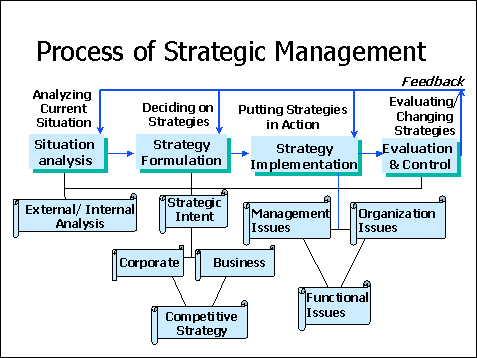
The conclusion of this chapter that I can share is  the comprehensive collection of ongoing activities and processes that organizations use to systematically coordinate and align resources and actions with mission, vision and strategy throughout an organization. Strategic management activities transform the static plan into a system that provides strategic performance feedback to decision making and enables the plan to evolve and grow as requirements and other circumstances change. We also can learn about art and science of formulating, implementing, evaluating, cross functional decision an enable of organization to achieve its objectives.


As this definition implies, strategic management focuses on integrating management, marketing, finance or accounting, production or operations, research and development, and computer information systems to achieve organizational success.  Sometimes the term strategic management is used to refer to strategy formulation, implementation, and evaluation, with strategic planning referring only to strategy formulation.  The purpose of strategic management is to exploit and create new and different opportunities for tomorrow, long-range planning, in contrast, tries to optimize for tomorrow the trends of today.   

       Formulating is develop mission and vision and also identify organization external and internal environment (SWOT) analysis. It also establish long term objectives and generate how to achieve vision and mission.

      Second, implementing. In the next step we also establish objectives, device policies, motivate employees, allocate resources so that formulate strategic can be executed.  And finally we need to evaluate.

Developing a vision statement is often considered the first step in strategic planning, preceding even development of a mission statement.
Mission statements are “enduring statements of purpose that distinguish one business from other similar firms.  A mission statement identifies the scope of a firm’s operations in product and market terms.” 

Okey..thats all..thanks for reading..;)...I will continue for next entry..See you again..keep smiling...